
POOL KITS MAINTENANCE
Pool kits maintenance is important and super easy! Remember a swimming pool is an equity building investment and with proper care will last you and your family for years to come. So please make time to focus on your pool kits maintenance, it’s not hard and only takes a few minutes each day during swimming season. We’ve put together a few notes and tips for making you pool kits maintenance easy. Please take a few minutes to read through our pool kits maintenance guide and if you have any questions please feel free to contact us.
POOL KITS MAINTENANCE – WATER LEVEL
DO NOT DRAIN your Swimming Pool. Our pool kits made of fiberglass are meant to stay full of water all the time. You will run the risk of causing your inground swimming pool to crack or even buckle due to ground or hydrostatic pressure outside the pool kit. Also, all responsibility for the damage will fall to you due to improper drainage. If you absolutely must drain your inground swimming pool kit, then please contact your dealer or the manufacturer.
OPTIMAL WATER LEVEL
Try to maintain a water level in the center of the skimmer on the swimming pool kit walls. Lower water levels can cause pump damage as the circulating pump loses prime. Higher water levels can decrease the effective of the inground pool skimmer.
POOL KITS SURFACE CARE
You may notice a “bathtub” ring forming on the walls or tiles of your swimming pool kit. These are typically caused by sun tanning lotions, body oils, or other non-abrasive contaminants. Luckily, you can easily remove them with some inground pool tile cleaner or other non-abrasive commercial tile or vinyl cleaner. It is imperative that you DO NOT USE any abrasive cleaners or materials such as metal scrapers, brushes, or steel wool on your swimming pool kit or you will more than likely permanently damage the gel coat finish. You can restore the gel coat of your pool kit with heavy coat automotive polishing compound that you may apply with a specifically-designed power tool or by hand along with a coat of wax. Still, the gel coat is no different than any other glass surface in that it will easily scratch. Hairline cracks may also develop over time and can be easily repaired. Even though the scratches may only be cosmetic, we still recommend that you take steps to avoid scratching your pool kit when cleaning the surface.
POOL KIT MAINTENANCE – SWIMMING POOL EQUIPMENT
VACUUMING YOUR SWIMMING POOL
Vacuuming your swimming pool is a an important part of your pool kits maintenance. A good portion of dirt and debris that sinks to the bottom of your pool kit can be brushed toward the main drain to be trapped in the filter. However, heavy amounts of dirt and debris should be vacuumed out. An inground pool kit vacuum operates on the same principle of a normal household vacuum. A swimming pool vacuum relies upon water suction instead of air suction to remove the dirt and debris.
Vacuum Instructions:
- Turn on the swimming pool kits pump and, if so equipped, turn the skimmer or vacuum valve open and the main drain closed.
- Remove the skimmer lid and basket. Note: If so equipped, leave basket in place and install the vacuum plate.
- Attach the vacuum hose to the vacuum head and attach the vacuum pole to the head.
- Sink the vacuum head to the bottom of the pool kit, then fill the vacuum hose with water by holding the open end of the hose over a return inlet until all the air is removed from the hose.
- Insert the open end of the vacuum hose through the skimmer top into the suction outlet. Note: if the inground pool kit is equipped with a dedicated vacuum wall fitting, insert the open end or the hose into the fitting.
- Vacuum swimming pool kit slowly from shallow to deep end. Note: Do not vacuum large leaves or debris as it may clog the plumbing lines.
- When vacuuming is complete, empty and replace the skimmer basket and re-open the main drain valve.
- Check the filter pressure gauge and if required, back wash or clean the pool kit filter.
POOL KIT SKIMMER
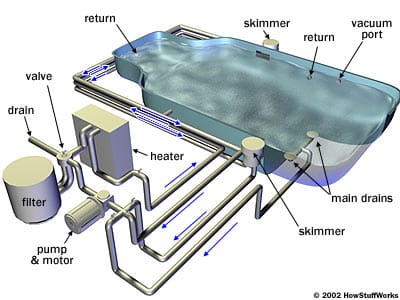
Water flows from the inground pool kit through the skimmer then into the pump. The swimming pool skimmer is designed to break water surface tension and remove floating debris as it floats by the skimmer opening. The flapper (weir) inside the skimmer throat allows debris to flow into the inground swimming pool kit skimmer then keeps it from drifting back out. Be sure the weir opens and closes freely. If stuck in the closed position, water from the pool kit cannot flow freely into the skimmer and pump damage may result. Debris caught in the skimmer basket should be removed and emptied as required. Excessive debris can clog the basket resulting in ineffective skimming and or damage to the swimming pool pump.
To help with your pool kits maintenance Pool Warehouse now recommends that all of our pool kits come standard with an Aqua Genie by Hydra Pools. This skimmer system is hands down the BEST system on the market for inground swimming pool kits.
MAIN DRAIN
Water from the bottom of pool kits flow through the main drain to the pump. The term main drain implies a way to remove the swimming pool water, however its primary purpose is to circulate deep water, not drain the inground pool.
POOL KITS MAINTENANCE – VARIOUS ITEMS
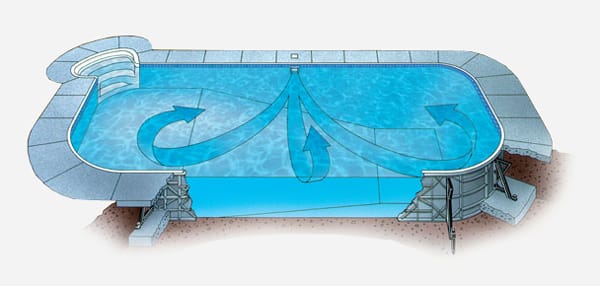
Return Inlets. The adjustable return inlets return filtered water back to the pool kit. Adjust one return inlet down and to the left of center. Adjust the other slightly up and left of center. This allows both deep and shallow water circulation along with clockwise water rotation.
Swimming Pool Kit Pump and Motor. The pump and motor pull water from the main drain and or the skimmer, then pushes the water through the filter and, if so equipped, through the heater, brominator or chlorinator then back to the inground pool return inlets. If allowed to run dry, the pump and adjacent piping can be damaged.
Strainer (next to pump). The lint and hair strainer basket collects lint, hair, etc., and prevents it from entering the pump and filter. Clean as required. Before removing lid to strainer basket, be sure to turn motor to pump OFF. After strainer lid is re-secured, turn pump on, and open air relief valve on top of filter. Silicone based grease or aqua lube on the O-ring in the lid will assure you of a better seal. Sandy dirt collected in the bottom of the strainer housing can be washed out by removing the 1/4 inch plug at the bottom of the strainer housing and flushing with a hose.
Time Clock. The time clock turns the swimming pool pump motor on and off at adjustable pre-determined times. For best results the time clock should run the pump 6 to 8 hours when water is at swimming temperature and 3 to 5 hours at lower temperatures. It is best to set the time clock to cycle on and off twice in a 24 hour period to better balance circulation, filtration and sanitizer disbursement.
Light. Consult your dealer for bulb replacement and instructions.
Swimming Pool Filter. Your inground pool kit filter is designed to mechanically clean your swimming pool kits water by trapping tiny particles inside. The cleaner the water, the less sanitizer and water chemistry adjustments will be required. Taking care of your pool filter is an important part of your swimming pool kits maintenance.
Filter Pressure Gauge. The pressure gauge located on top of the filter tells you the condition of your filter and circulating system. With the filter clean and the suction and return valves open, check and note the gauge reading. When the gauge rises 10 pounds above this starting pressure, it is time to clean or backwash the filter. If the gauge falls below the starting pressure, check the skimmer and hair and lint strainer for debris. If the reading remains low, check for an air leak at the hair and lint strainer lid. If low pressure persists, check for cracked or broken piping on the inlet side of the swimming pool pump.
Follow manufacturer’s instructions for operation and maintenance for other equipment and accessories involved with your pool kits maintenance.
POOL KITS MAINTENANCE – WATER CHEMISTRY
There are 4 components that make up swimming pool water chemistry; PH, total alkalinity, calcium hardness and T.D.S.
- Potential Hydrogen (pH) is the relative acidity orbasicity of your swimming pool water. For example: low pH would be acidic and high pH would be basic. The human tear has a pH value of 7 and is classified as neutral. The ideal pH value for your pool kit is 7.2 to 7.4. pH levels should be checked bi-weekly.
- Total Alkalinity (T.A.) is composed of the minerals in your inground pool kit water that buffer pH and is measured in parts per million (1 P.P.M.= 1 part per million parts of water). If the mineral levels are too high, then the pH will constantly drift up. If the mineral levels are too low, the pH will drift down or fluctuate. The proper total alkalinity level for your swimming pool kit is 70 to 80 P.P.M. and should be checked weekly.
- Calcium Hardness (C.H.) is the relative hardness of your inground swimming pool water, and is measured in P.P.M. If the water is too soft, it will be aggressive and erode pool kit equipment such as heaters, ladders and even the gel coat finish. If the water is too hard, deposits will form on the swimming pool equipment and finish. 300 to 350 P.P.M. is the proper hardness for pool kits and should be checked monthly.
- Total Dissolved Solids (T.D.S.) are the sum total of all materials in solution in your swimming pool kit water, and is measured in P.P.M. T.D.S. should be checked annually by a pool store professional or service company. T.D.S. above 1,500 P.P.M. reduces sanitizer effectiveness and causes the water to become abrasive.
Note: During periods of heavy rain or high swimmer loads, all of the above water chemistry valves, except T.D.S. should be checked more frequently.
When tests show all the above water chemistry items to be within the recommended ranges, it is in balance. Balanced water will be clean, clear, blue and will sparkle. Eye and skin irritation will be reduced, and pool kit equipment and gel coat surface life will be extended. Balanced water improves sanitation effectiveness and reduces or eliminates the necessity of adding costly water chemistry supplements. Prolonged improper water chemistry and high sanitizer levels can lead to swimming pool equipment and gel coat damage which may not be covered by your inground pool kit warranty. Remember that proper water chemistry is an important part of your swimming pool kits maintenance.
START UP WATER CHEMISTRY STEPS
- Adjust PH level to 7.4 – 7.6 by using testing kit supplied with your swimming pool kit.
- Add Chlorine Stabilizer per instructions on label of stabilizer container.
- Super chlorinate with chlorine per instructions on label of chlorine container.
- Turn on your pool kit pump which will initiate filtration. Run the pump continuously for 24 hours.
- Clean your filter medium by hosing off your cartridges or backwashing. (See filter instructions.)
Repeat steps 3 and 4 until water is clear.
WATER SANITATION
Bromine and chlorine are the most popular pool water sanitizers for inground pool kits. Alternate sanitizers are available and can be effective. Contact your dealer or swimming pool professional regarding alternative sanitizer.
Bromine and chlorine kill bacteria and control algae in swimming pool kit water when maintained at relatively low but constant levels. At higher levels, they become shocking agents that kill algae and oxidize organic waste such as body oil, urine, perspiration and air borne contaminants.
Bromine is less caustic and aggressive than chlorine, resulting in reduced eye and skin irritation. Bromine will not fade bathing suits or yellow blonde hair. Bromine adds gentle action will prolong the gel-coat pool kit finish and equipment. The primary advantage of chlorine is lower product cost.
If bromine or chlorine levels are allowed to fluctuate from low to normal, algae has an opportunity to flourish at the lower levels then become uncontrollable at the normal levels.
Do not use your pool skimmer as a sanitizer feeder. Not only can this lead to damage to your inground swimming pool kit equipment, it is inefficient and costly. Bromine and chlorine can both be fed to your swimming pool water through relatively inexpensive inline feeders. Chlorine can also be fed through a floating chlorinator. Do not use chlorine on indoor swimming pool kits. The gases from chlorine in water are carcinogenic.
Bromine Sanitation. Fill your brominator with bromine tablets and set the feeder to full open. Run the filtering system 24 hours a day and periodically test the bromine level until the bromine readings reach 3 P.P.M. Then adjust the bromine feeder to half open and set your swimming pool pump time clock to the selected operation time. Check the bromine level 24 hours later. If the bromine reads high or low, adjust the feeder accordingly and recheck 24 hours later. Bromine levels should be checked at least bi-weekly after the initial adjustments.
Chlorine Sanitation. There are 4 generic types of chlorine readily available for residential pool kits.
| Chlorine Type | Package | Primary Use | Ingredients |
|---|---|---|---|
| Calcium Hypochlorite | Granules Tables | Shock Feeder | 65% calcium, 35% chlorine |
| Sodium Hypochlorite | Liquid | Shock | 12% chlorine, 88% salt water |
| Trichloro | Tablet | Feeder | 95% chlorine, 5% cyanuric acid |
| Dichloro | Granular | Shock | 85% chlorine, 15% cyanuric acid |
In line, Off line, and floating chlorine feeders are available for dispensing chlorine to your swimming pool water. (See bromine sanitation for chlorine feeder instructions.)
Chlorine is rapidly exhausted by ultra violet light. This results in excessive consumption in summer’s direct sun. Cyanuric acid (stabilizer or conditioner) may be added to your inground pool kit water. Cyanuric acid acts like an invisible blanket that stops U.V. attack, and is most effective when kept at 40 to 60 P.P.M. Cyanuric acid does not degrade or evaporate so caution should be used not to add too much. High levels of cyanuric acid reduce chlorine effectiveness and distort water chemistry values.
SHOCK
Organic contaminants including saliva, urine, body oil, sun tan lotion and air borne particles build up in pool kit water and combine with sanitizer. The result is bromamines (Bromine) or chloramines (chlorine) which give off a strong odor and can dramatically reduce the sanitizer effectiveness. These contaminants can be eliminated by oxidizing or shocking the swimming pool water. Bromine and chlorine sanitized pool water can be shocked by adding an appropriate amount of chlorine or potassium mono per sulfate (oxygen shock). See product container for proper application. Do not add shock products to your inground pool kit water in one location as this may result in damage to the gel-coat surface. Add small quantities in several locations around the swimming pool kit. When using gradual chlorine for shocking, dissolve the granular in a large pail of water, then add the liquid to the inground swimming pool kit water. Your test kit will indicate the need for shocking. It is also recommended that you shock your swimming pool water after heavy rains and high swimmer loads. Turn off your sanitizer feeder and operate the pool kit filtering system for 24 hours after shocking.
CHLORINE (REGULAR USE)
The water that goes into your swimming pool has its own characteristics. The surest way to determine its chemical makeup is to have your water analyzed by an inground pool supply company or your pool kit dealer. Normally, once your water is balanced the predominant chemical you will need to add to your water is stabilized chlorine.
Monthly chemical check by your swimming pool professional is recommended. Follow the directions on the chlorine/bromine label but remember that the dosages are designed for plastered pool kits which have greater chlorine demand. An extra dose of chlorine called “super chlorination” or “shocking” is periodically required in some locations to maintain proper water chemistry. Once each two weeks in summer months is normal.
SWIMMING POOL WATER TEST KIT
A good quality test kit is a big part of your pool kits maintenance and will pay for itself several times over by giving you control of your water’s chemistry balance and sanitizer level, thus eliminating the need to constantly add products to resolve water problems. Your test kit should be able to test pH, total alkalinity, calcium hardness and sanitizer level. The kit should include a cyanuric acid test for chlorine sanitized inground pool kit water. The kit should also include charts indicating the type and amount of products required to adjust your swimming pool water chemistry. Read the test kit instructions and practice its use. A little practice will soon instill confidence.
SWIMMING POOL KITS CHEMICAL PRECAUTIONS
DO NOT MIX DIFFERENT TYPES OF CHLORINE; FUMES, SMOKE AND FIRE MAY RESULT. DO NOT ALLOW CHLORINE TO COME IN CONTACT WITH PETROLEUM PRODUCTS OR ACID; FIRE OR EXPLOSION MAY RESULT. Store pool kit chemicals in tight containers separate from one another in a well-ventilated area. Measure and add chemicals separately. Do not mix with one another before adding to your inground pool water. Follow manufacturer’s instructions listed on product containers.
ALGAE CONTROL
Algae cannot adhere to your pool kit finish, but can grow and flourish in the swimming pool water. Algae blooms may first appear as cloudiness before it turns color. There are three primary types of algae: green, mustard (yellow or light brown) and black (blue-green). Black algae requires a rough porous surface to survive so it is of no concern in inground pool kits. Bromine and chlorine at normal levels are effective algae stats (able to control algae growth). Chlorine at 10 PPM. is an effective algaecide (able to kill algae). See container labels for proper application. Chlorine can be used in a bromine swimming pool for shocking or algae killing. Commercial algaecides are also available. Contact your dealer or pool kit professional for further information. Properly maintained water chemistry and constant sanitizer levels will effectively reduce or eliminate algae problems.
METAL PLATING (DISCOLORATION)
Most fill swimming pool kit water contains trace to measurable amounts of metals. Because these metals are completely dissolved in the water, they are invisible. Fiberglass acts as a magnet, attracting these metals and plating the gel-coat surface. This plating will not rub or brush off and appears as blotches or shading and may even take on bizarre appearances such as hand or foot prints. Iron deposits appear reddish or light brown, copper will be green or blue green, magnesium or cobalt is black. This plating can be removed almost immediately from swimming pools with the addition of metal removing agents to your pool kit water. Note: sequestering agents are not effective. Two products are very effective in removing these deposits. Metal Magic by Proteam Products and Jacks Magic by Crystalline Products. Metal Magic attacks all metals and converts them to a metal salt which is removed in the filtering process. Follow label instructions for proper application. Because calcium is a metal, occasionally metal magic will cause the calcium in your inground pool kit water to form cloudiness. Continuous filtration may remove this cloudiness. If not, a flocking agent can be used to settle the sediment to the swimming pool floor where it can be vacuumed out. Contact your dealer or swimming pool kit professional for further information on flocking agents.
Jacks Magic will effectively remove iron deposits from the pool’s surface but will not remove it from the water. An additional Jacks product must be added to coagulate the metals into a filterable mass.
Swimming Pools sanitized with chlorine must have chlorine levels reduced or removed for Jacks Magic to be effective.
NOTES
If you elect to have your pool kits maintenance done by a outside service, please have them review this manual. It is important to have your pool kits maintenance company follow the water chemistry values for these pool kits. In some areas of the country, winterizing your swimming pool is recommended. Contact your pool kits maintenance company for specific information. The swimming pool kit accessories and attachments on your pool are manufactured by others and have separate warranties. Contact your accessory manufacturer for specific information.
SWIMMING POOL KIT RULES (SUGGESTED)
Now that you are an inground pool owner, neighbors and friends will want to enjoy your pool. Here are a few reminders to keep your swimming pool kit from becoming the neighborhood community pool. Like anything new, your swimming pool will be shown off to your friends and neighbors. Why not? You’re justifiably proud of your new inground pool kit, and you want them to see it. Yes, you may even want them to swim in it.
If you want to enjoy your own privacy with your swimming pool and not let it become the community “swimming hole” you had better consider some of these suggested pool kit rules. (These can be copied and passed out to your neighbors, etc.).
INGROUND POOL RULES
(The manufacturer in all his wisdom suggested we give these to all who might use our new swimming pool kit! We hope you will!!!)
- Phone before you come over. Guests, illness, etc. can make it impossible to accommodate more guests.
- Kids are welcome ONLY when accompanied by at least one parent.
- Could you bring your own towels?
- Help us, actively, keep the swimming pool clean. Just ask, we’ll show you!
- NO RUNNING AROUND THE SWIMMING POOL!
- NO SPLASHING!
- No cats, dogs or pets of any kind. (Animals, as a rule, have 100 times more bacteria than a human. Besides, they don’t talk.)
Try to establish guest rules up front with your swimming pool kit. Most people do not want to take advantage of your hospitality, but it is very difficult to establish rules after they have become a habit. Now sit back and enjoy your new inground swimming pool kit and don’t forget your pool kits maintenance!
Pool Kits Maintenance Questions?
If you have questions about your pool kits maintenance please feel free to give us a call at 1-800-515-1747 or send us an email, [email protected]. With over 15 years of online sales experience you can feel confident that Pool Warehouse is the #1 source for buying inground swimming pool kits online!
